BraceRecoveryGuide SEO Case Study: How We Ranked on Google in Just 2 Months
Most SEO “results” you see online are screenshots with the numbers cropped out, or vague promises like “we’ll get you to page one.” This bracerecoveryguide SEO case study is different: it’s a real, live website bracerecoveryguide.com — with the actual numbers behind how it moved from zero visibility to ranking, indexed, and pulling in consistent organic clicks within two months of publishing.
This isn’t a theoretical exercise. Every number in this bracerecoveryguide SEO case study comes straight from Google Search Console, pulled directly from the property for bracerecoveryguide.com.
The Starting Point of This BraceRecoveryGuide SEO Case Study
BraceRecoveryGuide.com is a niche content site built around a simple idea: people searching for medical braces — elbow braces, knee braces, wrist supports — are usually dealing with a specific injury and a specific body type, and generic “best of” lists rarely answer their actual question. So instead of publishing broad, shallow content, the strategy was to target highly specific, intent-driven queries: things like “best knee brace for LCL injury” or “best elbow brace for large arms.”
These aren’t high-volume keywords. They’re not going to bring in six figures of traffic on their own. But they convert, because the person typing that exact phrase into Google already knows what’s wrong with them and is actively looking for a solution — not just browsing.
That’s the bet the site was built on, and it’s the core of this bracerecoveryguide SEO case study.
The 3-Month Numbers
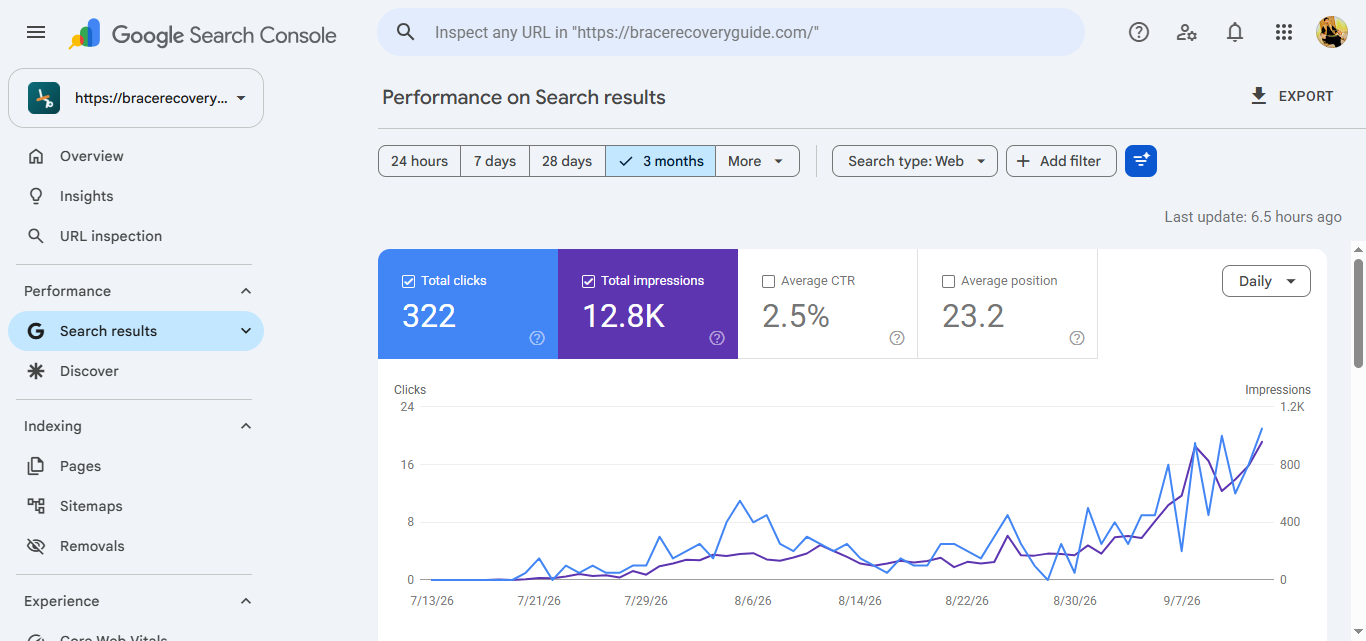
Looking at the last three months of Search Console data for bracerecoveryguide.com:
- 322 total clicks
- 12.8K total impressions
- 2.5% average CTR
- 23.2 average position
The growth curve tells the real story here. For the first several weeks, both clicks and impressions sit close to flat near zero — that’s the indexing and “Google sandbox” period every new site goes through, where pages are crawled but not yet trusted enough to rank anywhere meaningful. Then, starting in mid-August, both lines start climbing, and by early September they’re moving sharply upward together, with clicks and impressions rising in near-lockstep. This part of the bracerecoveryguide SEO case study is the clearest signal that the content isn’t just getting indexed — it’s genuinely climbing the rankings.
The Last 24 Hours: A Snapshot of an Active Site
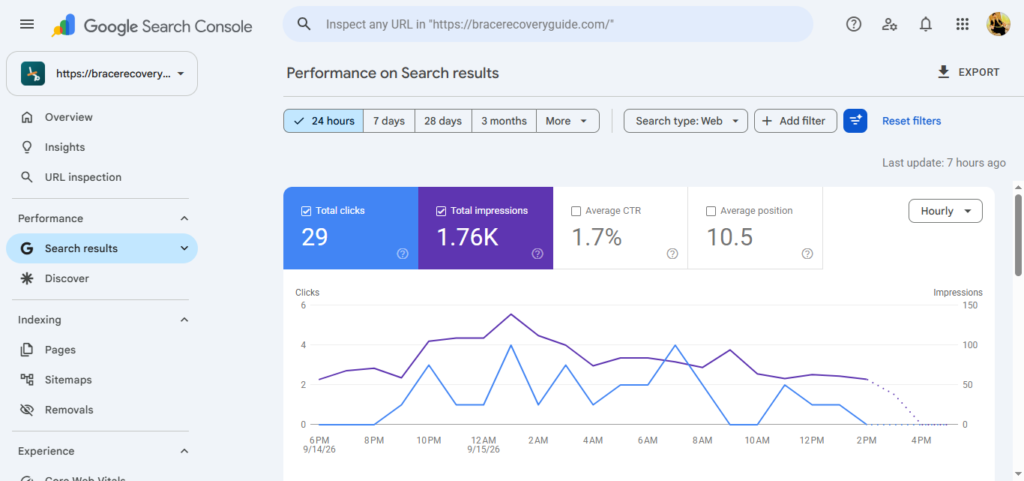
Zooming into just the most recent 24-hour window paints an even clearer picture of where the site stands today, and adds another data point to this bracerecoveryguide SEO case study:
- 29 clicks
- 1.66K impressions
- 1.7% average CTR
- 10.2 average position
An average position of 10.2 in a single day is a meaningful marker. That’s the site sitting right at the edge of page one for a meaningful chunk of its ranking keywords — not buried on page three or four where most new content lives for months. It’s what a healthy, actively-growing content site looks like on any given day once the initial ranking phase is behind it.
The Keyword That Proves the Strategy: “Best Knee Brace for LCL Injury”
Numbers in a dashboard are one thing. Seeing the actual result in a live Google search is another, and it’s the strongest single proof point in this bracerecoveryguide SEO case study.
Search “best knee brace for LCL injury” today, and bracerecoveryguide.com’s article — Best Knee Brace for LCL Injury (2026) — Top 6 Picks — sits in the top few organic results, right alongside established competitors and above several other content sites that have been publishing for far longer.
What makes this result worth highlighting isn’t just the ranking position — it’s the timeline. This page went from unpublished to ranking on page one in under two months. For a brand-new site with no existing domain authority, no backlink profile to speak of, and no history with Google, that’s a fast turnaround. It didn’t happen by accident — it happened because the content was built to directly answer the query: real in-depth reviews (DonJoy Playmaker II, Bauerfeind GenuTrain S, McDavid, and others), structured with the specificity that both readers and Google’s ranking systems reward.
What’s Being Built Next
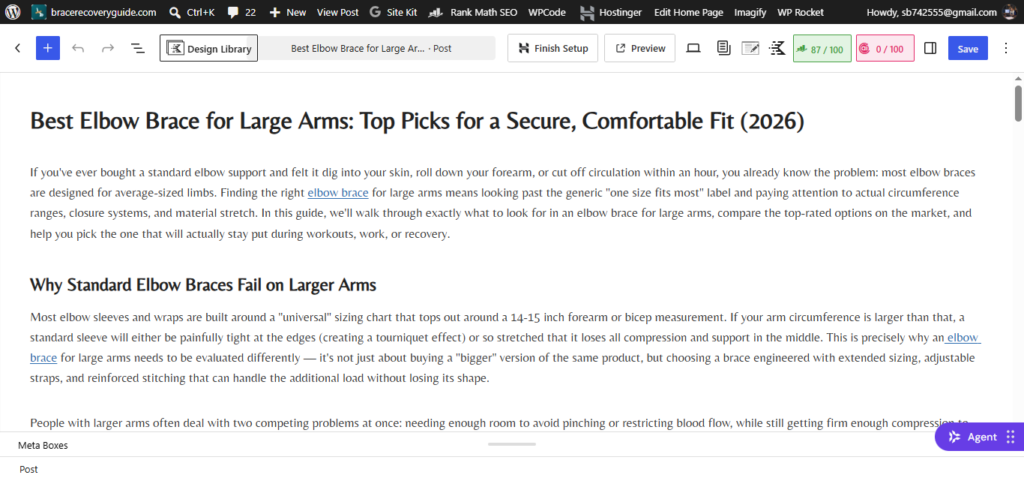
The strategy behind this bracerecoveryguide SEO case study is already being repeated. Sitting in the pipeline right now is “Best Elbow Brace for Large Arms: Top Picks for a Secure, Comfortable Fit (2026)” — another example of the same approach: identify a real, underserved search intent (in this case, people whose arm size makes standard elbow braces uncomfortable or ineffective), and build content that speaks directly to that problem instead of a generic buyer’s guide.
The article opens by naming the exact pain point most competitors skip past — standard sleeves either dig in or lose all compression on larger arms — before walking through sizing, closure systems, and material stretch as the actual criteria that matter for this audience. That’s the same content DNA that made this bracerecoveryguide SEO case study possible in the first place, and it’s the reason we’re confident the elbow brace article will follow a similar trajectory.
Why This Approach Works
A few things stand out when you look at what’s driving the results in this bracerecoveryguide SEO case study:
1. Specific queries over broad ones. “Best knee brace” is a brutally competitive search term dominated by huge, established health and fitness publications. “Best knee brace for LCL injury” is a fraction of the competition, with an audience that’s further along in their decision-making process and more likely to convert.
2. Content that actually answers the question. Every article is structured around the real-world problem the searcher has — arm size, injury type, recovery stage — rather than a generic top-10 list that could apply to anyone.
3. Consistent publishing. The upward trend in the 3-month chart isn’t from one lucky article. It’s the compounding effect of multiple pages targeting multiple long-tail queries, each one adding a small stream of impressions and clicks that adds up.
4. Technical fundamentals in place. With tools like Rank Math SEO already integrated into the site’s publishing workflow, each new article is optimized for on-page SEO from the moment it’s published, rather than needing retroactive fixes months later.
The Takeaway
Two months is a short window in SEO terms — most agencies won’t even promise visible movement that fast. But this bracerecoveryguide SEO case study shows what’s possible when a site is built around specific, intent-rich keywords instead of chasing broad, oversaturated terms: an average position of 10.2 in the last 24 hours, 322 clicks and 12.8K impressions over the last three months, and at least one article — the LCL knee brace guide — sitting on page one of Google against far more established competition.
If you’re building a content site, a review site, or an affiliate property and wondering whether this kind of growth curve is realistic for your niche, this bracerecoveryguide SEO case study is the honest answer: it is, if the content is built the right way from day one.





One Comment